Category: awareness

  • Why do you do what you do?

    Do you ever ask yourself this question? Do you ever wonder what makes you make the choices you make?

    Last week someone asked me why I still have this blog and I was speechless. Um, what do you mean by “still”? Was there a reason I should have stopped that I am not aware of? I sat for a minute and pondered the question. Why do I have this blog?

    Well, as the name of my blog says, Life with Dylan Inspires me to see the world a little differently than I did before. So I guess this is where someone could use the word, still.

    Yes, the subject matter of my blog changed a few years ago, but that is because my muse changed. What inspires me to write and to share changed. So why do I continue?

    I am a writer – and writers need to write. I am a photographer – and photographers need to share their pictures.

    As a conservationist, I have a passion for saving the world. Can one person save the world? Probably not, but one person can make a difference … and I intend to do just that by creating awareness. Whether one person or a hundred people read what I write does not matter to me. What does matter to me is that the people who do read my blog are inspired in some small way to make a difference of their own.

    Maybe I will inspire someone to start recycling, or to make that photography hobby a way to share the world with others. Maybe I will teach someone about an endangered animal and maybe, just maybe they will share what they learned. You see, sharing is the foundation of creating awareness.

    I write because I want to share. I share what I am passionate about.

    Writing and taking pictures makes me happy.

    So, back to the question. Why do I do what I do?

    Because it makes me happy.

  • California condors – Bald, Beautiful and Back from the brink of extinction

    Most people associate vultures with darkness and death because that is how movies, television, and books have portrayed them for so long. Yes, they do feed on carcasses of other animals, but this doesn’t make them bad. On the contrary, vultures are a very important part of the food chain and in turn the ecosystem as a whole. Try to imagine a land filled with rotting animals carcasses … it’s not a pretty picture is it?

    The California condor is in the vulture family and at one time, not too long ago, was teetering on the brink of extinction. Once widely spread throughout the western United States and Mexico, in 1982 the number of California condors dwindled down to only 22 in the wild.

    Destruction of habitat played a big part in the loss of birds, but an even bigger role was played by lead poisoning. Lead bullets used for hunting were being ingested by the California condors, which resulted in lead poisoning and ultimately their demise. So once again, the carelessness of humans was to blame for another species fighting to stay alive.

    In 1982, San Diego Zoo Global was given permission to start the very first captive breeding program for the California condor. At the time, this was quite controversial because eggs were being removed from the wild. Well, all controversy aside the captive breeding program was put into motion.

    Just this week, three of the four original eggs that were the first to be hatched celebrated their 30th birthday at the San Diego Zoo Safari Park. These three condors, Saspe, Sisquoc, and Almiyi helped form the foundation of what we know as the condor recovery program.

    Dylan and I have a great appreciation for the California condor. They are powerful and majestic animals who deserve just as much love and respect as the cute and cuddly animals. On a recent visit to the San Diego Zoo, we had the opportunity to see these birds up close at their exhibit. Unlike other visits when the birds were perched high atop the branches, they were right up at the glass. As we watched them and admired the beauty of the black feathers cloaking their necks and the different shades of pink and varying degrees of baldness; we overheard some things that were not very nice. In fact, they were pretty upsetting to us.

    “What ugly buzzards”

    “Freaks!”

    And my personal favorite …
    “Why would anybody want to have this at a zoo?”
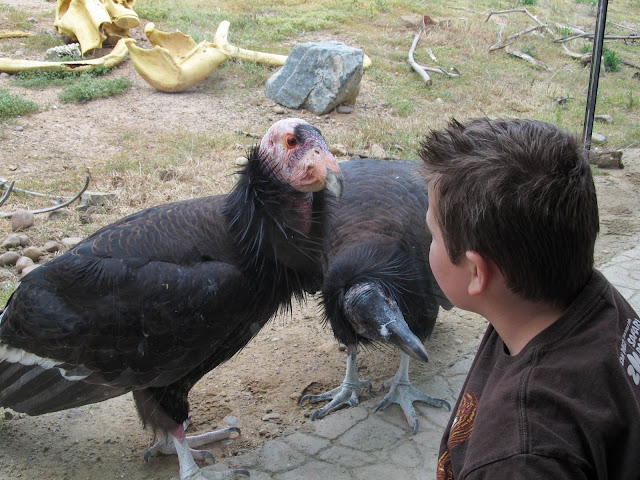
    Dylan having a conversation with the California condors at the San Diego Zoo

    Obviously these people are uneducated and unable to see the beauty of these birds. Rather than put down the California condor for its appearance and the folklore that has given them a bad name, these people should be thankful. Thankful to San Diego Zoo Global for starting the condor breeding program. Thankful that they are able to see a California condor in real life instead of just a picture in a book listing extinct animals.

    San Diego Zoo Global stated that the Safari Park has hatched over 170 chicks and released more than 80 birds in the wild. Currently there are now more than 400 condors, more than half of which are flying free in California, Arizona, and Baja California, Mexico. That is a far cry from the 22 California condors in 1982.

    A prime example of how together, we can make a difference and bring a species back from the brink of extinction.

    To learn more about the California condor and the condor recovery program you can visit the San Diego Zoo Global Wildlife Conservancy Success Stories page.

  • Endangered Species Monday – Let’s Save the Rhinos in 2013

    I could never choose just one animal. I mean really, let’s face it, if I could save all the endangered species I would. To say that one is more important than another is not right because they are all equally important and needed on this planet. However, sometimes one animal stands out among the rest. For me that animal was a rhino. A special connection was made the moment that I touched and fed the rhino brothers at the San Diego Zoo. I had looked into the eye of an endangered species and I would never be the same.

    In December I made a decision to make 2013 the year that I personally made a difference for the rhinos. After reading recent news articles, I have never been more sure of a decision.

    A record 668 rhinos were killed in South Africa in 2012 – that is a 50% increase over 2011. This figure astounds me. I shed a tear for each one of the rhinos lost when I read articles about the killings. We must put a stop to poaching and educate people about what rhino horn really is – keratin – the same thing as out hair and fingernails. Rhino horn is not medicine!

    Just when I thought it couldn’t get any worse, I saw this headline on twitter the other day Poachers hack baby rhino with axe … Wait, was I reading this right? This couldn’t possibly be true. What good is killing a baby rhino? There is no horn to take from a 2 month old baby rhino – this is uncalled for and made me so angry. So angry and so sad that all I could do was cry. This poor defenseless rhino was being attacked because she got in the way of the poachers who were cutting off her mother’s horn.

    2013 is not getting off to a very good start for the rhinos. As of January 11th, the death toll is already up to eight and if this baby doesn’t survive it will be nine. I have no time to spare. The number one way for me to help the rhinos is to create awareness. I will also share stories, photographs and raise as much money as I possibly can. So far I have two ways of raising money for the rhinos …

    San Diego Zoo Safari Park Half Marathon – I will not be able to run the half marathon because I am volunteering to help with the race and with Cinco de Rhino that evening. However, I can still virtually run the race and raise money for the greater one-horned rhinos. Your tax-deductible donation on my fundraising page will help make a difference. $5 or $10 or $25 it doesn’t matter – every little bit helps.

    I have also written a letter addressed to President Zuma as part of the One More Generation letter writing campaign. (Our letters are #557 and #558 – letters are listed alphabetically so scroll down to Fryer) These letters are a way of creating worldwide awareness and bringing our pleas to stop the poaching to President Zuma himself. I would love it if you would write a letter too!

    Something has to change. This needs to be the year that wildlife poachers are stopped before it’s too late. There is not much left that we can do for the Northern White Rhinos and the Javan and Sumatran rhinos are not far behind. If the numbers keep climbing at 50% increases, then we will be that much closer to another animal facing extinction.

  • I ignited a spark and now I want more

    After almost a year of talking about conservation and writing about how we can all make a difference, I finally saw that spark in someone’s eye. You know, that spark you see when something you said or did made another person think hey, I can do this too.

    The best part about this story – the spark I saw was in a child’s eye.

    A few weeks before Christmas a friend of mine told me that her son Riley (5 yrs old) saw a World Wildlife Commercial about saving the tigers and that he wanted to help save them, but he didn’t want to have to touch them. When I heard this I knew what I had to do.

    I would adopt Riley a tiger from the San Diego Zoo and give it to him as a Christmas gift. This way he could help save the tigers.

    Riley was so excited when we gave him his tiger. We told him that his name was Christopher from the San Diego Zoo and by adopting Christopher he was helping to save the tigers.

    Now Riley has a very special friend named Bear. Bear has been with Riley since the day he was born. Bear goes everywhere with Riley and there was a day not too long ago that Riley thought he had lost Bear. His Dad captured this beautiful image filled with emotion and a child’s love for an animal. So you are probably thinking what does Bear have to do with the tiger? Well, I had to let you know just how special Bear was for you to understand how special it was when I found out that Christopher (tiger) was traveling alongside Bear.

    Not only was Christopher hanging out with Riley and Bear, but Riley was telling people about his Mommy’s friend who adopted the tiger for him so that he could help save the tigers. A 5 year old boy creating awareness about the plight of the tigers as a result of something I did … you bet I’m on cloud nine!

    Oh, and he sleeps with Riley too.

    I’ve said before that educating children will change the world and when a child starts telling his friends and family about saving the tigers, well that just makes me more confident that I am doing something right. Riley brought Christopher to school today for share day. This, this is what it’s all about.

    iPhone pictures from today

    When I shared the news about Riley and his newly adopted tiger with a friend of mine he said, “Be careful … That feeling, the one you got when you saw that spark ignite because of you, it’s addictive.”

    Man was he right – I love it and want more! Every time Riley’s parents post a new picture and I see Christopher right there with him I get that feeling all over again. Riley is making a difference for the tigers by telling his friends about his adopted tiger and I am so proud of him.

    This is what I want from life – I want to make a difference and inspire others to do the same.

    Thank you Desi and Tammy for providing the pictures.

  • Endangered Species Monday – Saving rhinos one letter at a time

    I am a firm believer that the fate of our planet is in the hands of our children. My generation is trying to right the wrongs of my parents generation, but there isn’t enough time to do it all. Today’s children have the power and the desire to save this world and change things for the better. The more issues about conservation, wildlife poaching, and global warming that make the news and social media outlets, the more children become aware of what must be done.

    Since my son decided to raise money for the tigers, in lieu of his birthday a few months ago, I have become more aware of other children making a difference too. Children are fearless and believe that they can take on anyone – even the President.

    I came across an article today while reading Mother Nature Network that touched me and I was shocked that I hadn’t heard about this before. After doing some further reading, I realized that the campaign started shortly after my son was raising money for the tigers. Maybe I was so caught up in tigers at the time that I didn’t notice the work Carter and Olivia Ries of One More Generation (OMG) were doing for the rhinos.

    This brother and sister duo have teamed up with SPOTS (Strategic Protection of Threatened Species) and set a goal to collect 1,000 letters and or drawings addressed to South African President Jacob Zuma. How inspirational is that? And what a great way to get people of all ages from all over the world involved in saving the rhinos from extinction. Carter and Olivia plan on personally delivering the letters to President Zuma when they visit South Africa in 2013. The idea is to show him and his staff how much we in America (and all over the world) care for these animals.

    Your letter can be as long or as short as you like. Maybe you want to draw a picture or send a photograph showing how beautiful rhinos are. If you can’t think of what to say, you can use one of the form letters on the One More Generation website.
    Instructions on where to send your letters are detailed in the post Dear President Zuma, or you can even email your letter to info@onemoregeneration.org

    Dylan and I will be writing two letters this week to help Carter and Olivia reach their goal of 1,000 letters and I ask you to do the same.

    Make it a Christmas gift to the rhinos – the gift of your time to write a letter could save hundreds if not thousands of rhinos. Everyone can make a difference.

  • Endangered Species Monday – There is always hope

    Sometimes reading about endangered species can be difficult. Doing research to write about them is even more difficult. Oh, who am I kidding, it can be down right depressing. The word endangered “seriously at risk of extinction” alone breaks my heart. However, part of making a difference in this world is creating awareness; so I keep reading, I keep researching, and I keep writing.

    Every now and then I come across a success story or read about how a species, like the mountain gorilla is showing an upward climb in population. This my friends makes all the difference. Then there are the stories that bring me so much joy and hope that I can’t help but smile for hours.

    This is one of those stories.

    According to the Albuquerque BioPark Zoo, the rhino was born at Florida’s White Oak Conservation Center on October 30 and weighed 132 pounds. Born on an unusually cold night, the calf struggled – he was slow to start nursing and did not establish a strong bond with his mother. When White Oak staff saw he wasn’t thriving, they decided to hand rear him. BioPark animal care staff traveled with the rhino from Florida and moved the now 169-pound baby into a behind-the-scenes area at the Zoo on the evening of Nov. 14.

    The Southern White Rhino almost went extinct in the early 1900’s with numbers dwindling down to 100, but thanks to conservation efforts, captive breeding programs at accredited zoos and conservation centers, and reserves, the Southern White Rhino population has climbed to over 20,000 individuals today.

    The fight to end rhino poaching isn’t over and there are still five other rhino species who need saving (seven if you count the Borneo and Northern White), but seeing this little guy walk out of a crate reminds me that there is always hope when dealing with endangered species.

  • Endangered Species Monday – Orangutan

    When I see an orangutan I can’t help but smile. These animals are so animated and they definitely have individual personalities. 

    Orangutans are also very much like humans – from their mannerisms to their emotional expressions. In fact, orangutans are closer to humans than you may think. They share 96.4% of our genetic makeup, which makes orangutans genetically closer to humans than any other animal. The female orangutan is considered to be one of the most caring and gentle mothers in the animal kingdom. 


    Some young orangutans will stay with their mother up to eight years; nursing for the first three years and then learning how to fend for themselves. 

    Although orangutans live a mostly solitary life, they create bonds that last a lifetime. It has been said that these bonds are renewed during forest encounters later in life. Aside from the nurturing and bonding, orangutans are highly intelligent animals that learn many things from copying. On several occasions, I have watched the orangutans at the San Diego Zoo cover up with large leaves or a burlap sack when it is raining. That is a pretty smart orangutan!


    Orangutans once lived all over Southeast Asia, but now only inhabit the warm tropical jungles of Borneo and Sumatra. Orangutans are the largest tree-dwelling mammal and are 100% dependent on the rainforest for survival. This being said, you can see why habitat conservation is so important. 


    From 1980-1990 heavy logging and land development reduced the orangutan population by 50%. Large forest fires destroyed more habitats in 1997. Today, the harvesting of palm fruit for the palm oil is one of the main causes of habitat loss for the orangutan. Palm oil is in everything from cookies, chocolate and cosmetics to biodiesel and unfortunately is not always labeled as palm oil. 


    A sign at the San Diego Zoo educates people about palm oil

    Recently there has been a lot of talk about the health benefits of palm oil and people are now actively looking for products with palm oil. This is not good for the survival of orangutans. If you must buy palm oil, then please support the companies who are members of the RSPO (Roundtable on Sustainable Palm Oil) You can find a printable shopping guide here. 


    Educating people and making them aware that our actions have a direct impact on the rainforest is imperative to saving endangered species. To save the orangutan we must first save their home. All attempts that we make to save the orangutans will ultimately fail unless we can assure that their quickly disappearing rainforest home will be there for many years to come.

    For more inofrmation on the palm oil crisis and what you can do to help visit the Cheyenne Mountian Zoo website.

  • The mind of a child wonders … Why?

    The other day my son began asking me questions. Questions that I could not answer.
    Good questions. In fact, amazing questions!

    WHY do people have to kill rhinos for their horns?

    WHY do people have to kill tigers for their fur?

    WHY do people have to harvest palm oil fruit from the rain forest?

    WHY do people have to kill elephants for their tusks?

    WHY do people have to be cruel to the animals?

    WHY do people have to litter at the zoo?

    WHY don’t more people recycle?

    WHY do people not take conservation seriously?

    WHY do people have to cut down the rain forest?

    WHY don’t people care about these things like I do?

    I decided to use his questions for a blog post because I began to wonder …


    WHY does a 9-year-old child question these global issues, when so many adults do not?

    Photo courtesy of Dylan Fryer.

  • School fundraiser does more harm than good

    Anyone who has children is familiar with the annual school fundraisers. Almost all schools have at least one fundraiser and I understand the reasoning. Budget cuts and minimal funding for programs like art and music have forced the schools to be creative in how they ask parents for money.


    Over the years my son has brought home packets with everything from cookie dough, wrapping paper, See’s candy, and the infamous magazine subscriptions. So you can imagine how happy I was to see that this year’s fundraiser was for reusable shopping bags and totes that were made from recycled products. Wonderful!


    I was ready to buy all my Christmas gifts and share the fundraiser with my coworkers, but then the little voice in my head told me to look deeper. I went to the company’s website and searched for the about page.


    I was shocked when I began to read what it said. – Shocked at the ignorance more than anything else.


    Made from woven polypropylene – one of the most popular plastics for making food containers like yogurt cups. 10-40% of the polypropylene used in our bags is recycled from post consumer use. Most of our bags hold up to 50 lbs, which is due to the plastic fibers woven into the bags. Made in China.

    Wait, was I reading this correctly? Made in China?


    Why on earth would I or anyone buy a product that is supposed to be eco-friendly from a California company that has the product made in China? The thousands of miles on diesel burning cargo ships and the trees that are destroyed to make the shipping crates are not eco-friendly. The size of the carbon footprint left to have a recycled product made in China, only to be sold in the United States is enormous in comparison to making the recycled product here. We strive to cut carbon emissions on our local streets, but pretend that the emissions made on the ocean don’t exist.


    My son’s school fundraiser ends today and I sent the envelope back as instructed. Not with an order form or payment, but rather a note to the school.


    Please consider another fundraiser next year. Although the bags are nice, there is no point in buying a recycled product that is manufactured in China. The pollution and environmental impact of transporting goods from overseas defeats the purpose of making and buying eco-friendly products. Thank you.


    So I’m curious, do you ever look to see where the eco-friendly products you buy are made?


  • Endangered Species Monday – Amur Leopard

    Photo by Penny Hyde

    Most people associate leopards with Africa or the snow leopard with Asia, but there is another leopard that deserves some attention – the Amur leopard.

    The Amur leopard does not live in Africa. This rare subspecies lives in the Russian Far East. They are one of the most stunning cats I have ever seen. Sadly, the Amur leopard is critically endangered with only around 30 left in the wild. 


    While habitat destruction is partially to blame, it is not the main reason for the decline in the species. The bigger problem is poaching and over hunting of the Amur leopards prey. As with other animals that have beautiful fur, the Amur leopard is hunted for its spotted fur and there is an insufficient amount of prey to sustain a large population in the wild.


    Once an animal reaches critically endangered status, strong measures need to be taken to ensure the survival of the species. In this case, an international conservation program was established. Although some people have mixed feelings on keeping wild animals in captivity, the conservation efforts made by several well-known zoos in the United States have helped increase the captive population to hundreds. In my opinion, this is conservation at its finest. Job well done.


    Photo by Deric Wagner

    In April 2012, the San Diego Zoo was fortunate to have three Amur leopards join their family. Koshka, Primoyre, and Zeya are siblings who arrived as part of the international conservation program designed to help save the Amur leopard. When they arrived they were playful 11 month old babies – running and jumping all over the place. I have been lucky enough to see these siblings on several occasions and they are so much fun to watch. However, when I watch them play I have mixed emotions. I feel blessed to have the opportunity to see such an amazing animal, yet I can’t help but feel sad knowing how critically endangered they are in the wild.


    Yes, there are other species of leopards … but there is only one Amur leopard. 


    Photo by Penny Hyde


    Special thanks to my friends Deric and Penny for allowing me to share your beautiful pictures of the Amur leopards from the San Diego Zoo.