Category: endangered species

  • When creativity and conservation come together

    I have heard it said by many that conservation is not a hobby or something people take lightly. Rather, conservation is a way of life. A passion. I could not agree more with these statements. Over the years it has become very clear to me that conservation is something Dylan is very passionate about. While my viewpoints are obviously shared and discussed with him, he makes his own decisions about where he will focus his conservation efforts and ultimately his fundraising. In the past, the choice was not always an easy one to make, but it was fairly cut and dry with large goals of $1,000. Tigers, then leopards, then rhinos. As soon as one project was completed, he was ready to move on to the next. Throw in the occasional symbolic animal adoption and that was our life.

    As Dylan continues to grow, so do his dreams of saving endangered species and changing the world. One project at a time just won’t do anymore. There are too many endangered species out there that Dylan wants to help. We needed to come up with a plan, so over summer vacation we brainstormed. We listed all the programs that we wanted to support in the next year or two and started coming up with ideas. Ideas of how we could raise the money without asking friends and family for donations. Dylan thought it would be good to sell something instead of only asking for money. I agreed.

    When creativity and conservation come together you get Creations4Wildlife. Inspired by the endangered species that we want to help save, we have designed several bracelets that we are selling as a way to raise funds to support our conservation efforts.

    Each piece of the collection is handcrafted by me and Dylan and the profits will be donated to the designated non-profit organization. We are currently raising money for the Tiger Conservation Campaign, International Rhino Foundation, Rhino Rescue Center, Giraffe Conservation Foundation, and Red Panda Network. Every purchase gives Hope that these endangered species can be saved.

    Working together on this new conservation project with Dylan has reminded me how important it is to never lose faith in your beliefs. No matter what the obstacles may be, another poaching story in the news or hearing that there are now only 4 northern white rhinos left, you just keep going.  Conservation is a way of life for us and I am confident that we can raise the funds and meet our goals. No question about it, this mother and son team are determined to make a difference for wildlife.

    To purchase one of bracelets please visit Creations4Wildlife.com
    Thank you for helping support our conservation efforts!
  • It’s Time To Get Serious About Wildlife Crime

    Wildlife Crime –
    You see it on the news and read about it on social media, but do you really know what it is? You might think you do. I know I did … until one day I came face to face with the reality of wildlife trafficking.

    This day was so intense that it has taken me two years to share my story. I thought about telling my story numerous times, but to be perfectly honest, it is a painful story to tell. Not many things stop me in my tracks, but this did. In fact, the experience literally took my breath away. I had to step back and remind myself to breath, remind myself that this was reality and that what I was seeing was meant to educate people about wildlife crime.

    On February 17, 2013 my son and I were attending an event at the San Diego Zoo called Discovery Days: Cool Cats. There were various booths set up for people to get information and learn more about what else, cats. Pet stores, animal shelters, organizations where you could adopt endangered cats, an artist sketching pictures of cool cats, and then we saw it. The booth that stopped my heart for a split second.

    A booth from the U.S. Fish and Wildlife Service.

    This was not an ordinary booth. This booth was specifically set up with one thing in mind.

    Wildlife Crime.

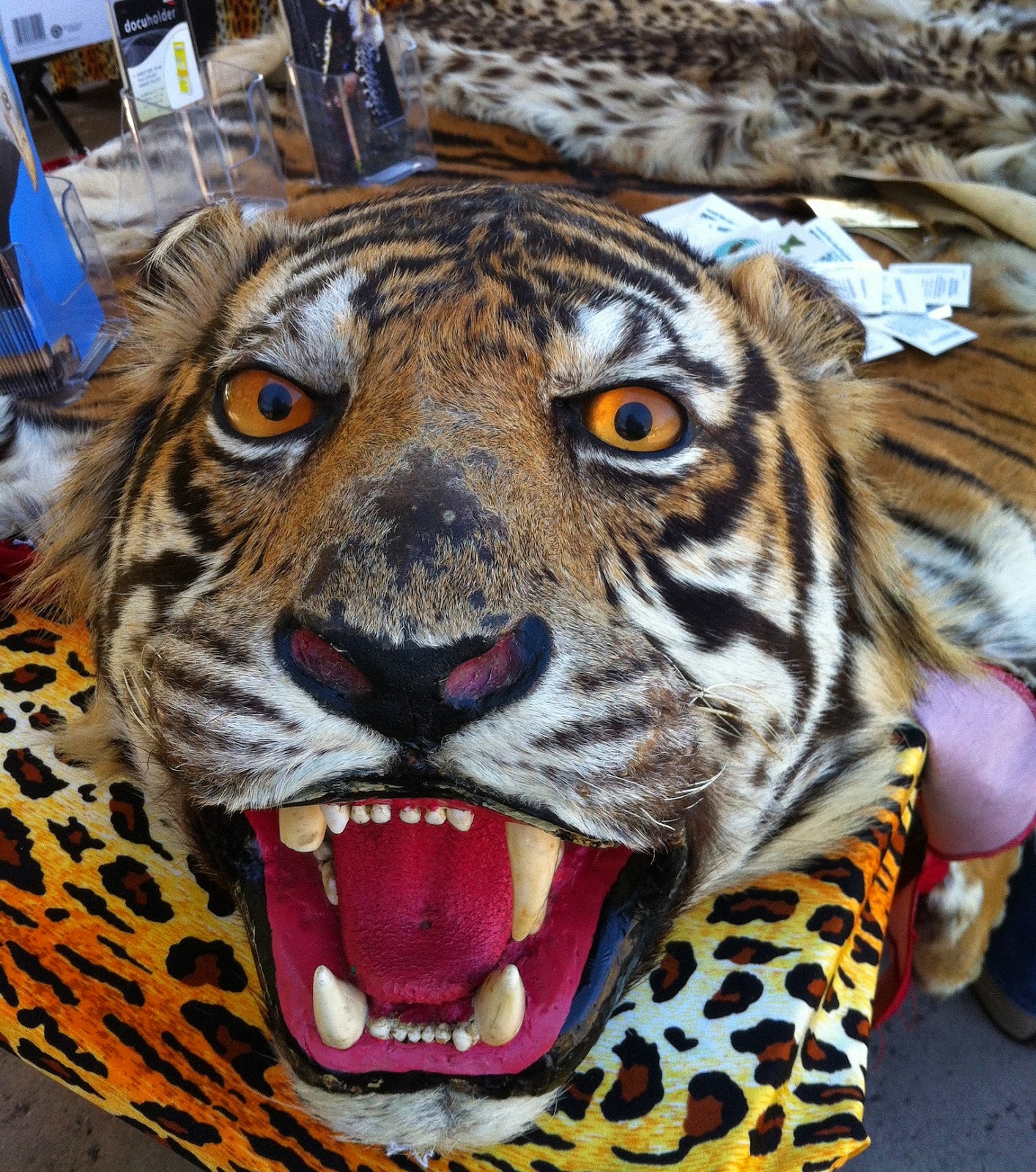
    I can still picture it clear as can be. It is an image that will never leave my mind. Fur coats hanging in the background. A female lion cub in a sitting position to the left. Full body skins of leopards, ocelots, jaguars, and other small cats to the right. Then there was the face, the face that was looking at me, the face that was attached to the skin and fur of a young tiger.

    The tears began to flow and I had to walk away. We both did. It was too much to take in.

    I was not prepared for what I was seeing, or for how I was feeling.

    Each item on display had a tag attached to it that read “These items are all genuine animal products seized by the U.S. Fish & Wildlife Service”.  I was looking at real animals that had been killed for their fur and body parts. This was the reality of wildlife crime. Yes, the fur was beautiful. However, I would have much rather seen it on a live animal. Was the fur soft? I don’t know, because I didn’t touch it. I wanted to know what a tiger felt like, I still do, but I couldn’t touch this one. It was just too sad.

    Many people were petting the skins, like they were pets or something. Some even made jokes. I chose not to engage in their uneducated conversations and chose rather to talk with the U.S. Fish & Wildlife officer that was there. I chose to educate myself more about wildlife trafficking. The sadness and pain didn’t go away, but I did become more determined to do everything I possible could to stop wildlife crime.

    This painful day is something that I will not forget. Nor will my son. It was a day that forever changed us and reminds us to keep fighting. This Tuesday, March 3, 2015 is World Wildlife Day –  a day to create awareness and work toward a future where people and wildlife can coexist.

    I chose to share my story this year in hopes of getting more people to stand up against organized wildlife crime. Please join me and thousands of others by using #SeriousAboutWildlifeCrime on your social media channels this week. Alone it is an uphill battle, but together we can save these animals and put an end to wildlife crime.

  • Choose One …

    How many times have you been asked to make a choice? To choose one thing over another.

    Almost daily, right? Although not an easy task, choosing a favorite color or favorite flavor of ice cream is something most people can do without too much hesitation. If asked to choose between a cat or a dog, most people favor one or the other. In general, you are either a cat person or a dog person.

    If I were asked, “Which endangered animal do you want to save?” I would have a difficult time answering. How can I possibly choose only one?

    My first response would be to save them all, but that is not the answer the average person is looking for. They want me to choose. To choose one over another.

    Do I choose a rhino?
    If so, which one?

    Black, Javan, Sumatran, Greater One-Horned, Southern White, or the almost extinct Northern White?

    Maybe I should choose a tiger… but wait, that only leads me to yet another choice…
    Which one?

    Sumatran, Malayan, Amur, Bengal, Indochinese, or South-China

    As you can see, there is no one easy answer. It is basically impossible for me to choose only one. Therefore, like so many other conservationists, I choose to save them all.

    Rhinos, Tigers, Elephants, Lions, Tasmanian Devils, Cheetahs, Gorillas, Snow Leopards, Orangutans, Polar Bears, Amur Leopards … These are just a few of the endangered animals that I have helped save through fundraising, symbolically adopting, and overall creating awareness through this blog, social media, and my photography.

    How I choose which animal to help save is constantly changing. Sometimes I attend a lecture and listen to experts speak about their work in the field, other times I read an article that captures my attention and ultimately pulls at my heartstrings when I learn of the continued poaching and wildlife trafficking.

    Then there are those times when I least expect it. When I am editing my photographs and an image speaks to me. A few days ago I was editing photos from a recent trip to the zoo and came across this image of Flynn the red panda – it spoke to me.

    Before I knew it, my next choice had been made and I was adopting a red panda named Niyati from the Red Panda Network.

    Who knows which endangered animal I will choose next.
    All I can say is that there will definitely be more than one.

  • Baby Black Rhino Charges Into Our Hearts

    Once again, the San Diego Zoo Safari Park is doing their part to bring species back from the brink extinction. Last week a critically endangered black rhino calf was born at the Safari Park and has quickly charged into the hearts of rhino lovers all over the world.

    The unnamed male calf was born on Saturday July 12, 2014. This is the fifth calf for Lembe and father Jambia and the 15th black rhino born at the Safari Park.

    Last Wednesday I was at the Safari Park and knew the chances of seeing the baby rhino were slim. Lembe is very protective and has been keeping him hidden among the rocks. Nevertheless, I got on the tram  … I just wanted a glimpse of the then 4-day-old baby rhino. Well, I got more than a glimpse.

    The tram driver was just as excited as we were. She said that we were very lucky because nobody had seen Lembe walk the calf across the exhibit. All I could do was start clicking my camera in hopes of getting something that resembled a rhino. I was so honored that the Safari Park used my photo to announce the birth of the black rhino calf on social media.

    In a press release from the San Diego Zoo Safari Park, keepers stated that Lembe runs around her exhibit with her tail pointed up, a cue that lets her calf know she is on alert and watching over him. The young calf trots closely behind, sometimes fumbling over his footing, as he is still getting comfortable keeping up with his mother.

    We have been watching Lembe has she grew bigger and bigger, anticipating the birth of this precious black rhino. Words cannot explain the excitement or the joy Dylan and I felt when we saw him running through the exhibit. Both mother and calf are visible to guests taking the Safari Park’s Africa Tram tour, so get out there and see this little guy for yourself. The cuteness factor is off the charts!

    Black Rhino Calf – Photo taken on July 18, 2014, by Ken Bohn, San Diego Zoo Safari Park

  • 10 Reasons for Hope for the Future of Wildlife

    Two years ago Dylan and I joined the fight to end extinction. Even though it can feel like an uphill battle most of the time, we keep holding out for a small victory. A glimmer of hope. A success story. The birth of an endangered species or the reintroduction of a species into the wild.  Something to let us know that we are making progress.

    “Today we are facing an extinction crisis, with species disappearing every day,” said Douglas Myers, chief executive officer and president for San Diego Zoo Global. “To combat this crisis we needed an audacious mission that focuses our efforts toward creating successful outcomes, even if we have to do it by saving one species at a time.”

    San Diego Zoo Global has more than 132 conservation projects in 62 countries around the world and has reintroduced more than 43 species back into the wild during its almost 100-year history. This is progress! Working together, we can create awareness and make a difference.

    In honor of Endangered Species Day, which was last Friday, May 16, San Diego Zoo Global released a list of success stories in the conservation of endangered species. Bringing species back from the brink of extinction is the goal and in my opinion, nobody does it better than San Diego Zoo Global.

    The Ten Reasons for Hope are listed as follows:

    1) Mountain yellow-legged frog recovered after wildfires. In 2002, fewer than 200 mountain yellow-legged frogs were left in the streams of Southern California’s mountains. Four years later, a group of tadpoles was rescued from fire-damaged habitat and brought to the San Diego Zoo Institute for Conservation Research. A team from San Diego Zoo Global, the U.S. Fish and Wildlife Service and the U.S. Geological Survey, U.S. Forest Service and California Department of Fish and Wildlife worked together to reintroduce and reestablish a wild population in the San Jacinto Mountains. Reintroduced males are now beginning to show signs of breeding behavior and scientists hope to see wild-hatched frogs in this area for the first time in 20 years.

    Mountain yellow-legged frog

    2) Giant pandas less rare than before. Not long ago, the future for the giant panda looked grim. Today, the captive population of pandas has reached the milestone of 300 bears, the minimum necessary to sustain 97 percent of the genetic diversity for the next 100 years. With wild populations stabilizing and even increasing, the giant panda may now be close to having its status changed from endangered to threatened.
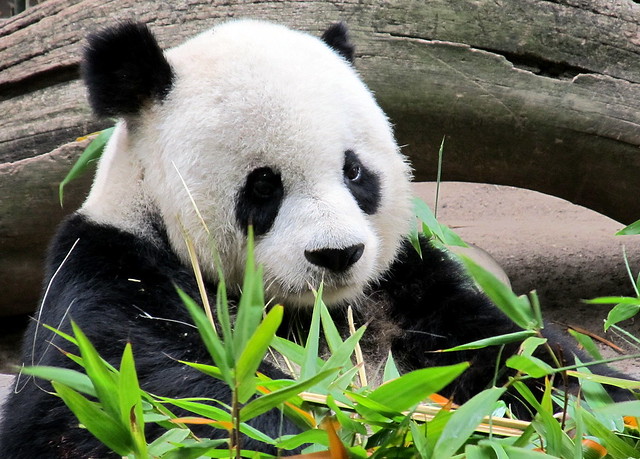
    Gao Gao

    3) Tecate cypress preserved for the future. San Diego Zoo Global partnered with The Nature Conservancy, the Bureau of Land Management, and the California Department of Fish and Wildlife to preserve the Tecate cypress, a conifer found in Southern California and parts of Baja California, Mexico. Numbers of this noble tree have declined rapidly in the past decade. Plant ecologists collected seeds from one of the last remaining cypress stands in California and established a nursery to produce seedlings. Some of the seeds were frozen and placed in the Native Plant Gene Bank at the San Diego Zoo Safari Park, protecting the species from loss by wildfires in the future.

    4) Tasmanian devil population protected from devastating disease. A deadly and contagious cancer called devil tumor facial disease has been wiping out entire populations of Tasmanian devils in the wild. Working with the Save the Tasmanian Devil Program, San Diego Zoo Global experts are helping to monitor healthy populations isolated from the disease so that the species can be recovered.

    5) Wild-hatched condors now in Baja California, Mexico. Overall, the California Condor Recovery Porgram now produces 12 to 15 chicks produced annually in the wild. Combined with birds raised in managed care, over 50 condors join the species count each year. In Baja California, Mexico, where San Diego Zoo Global is leading the recovery effort, the first released condors have become parents, with two chicks successfully fledged last year. As more wild condors transfer to natural foods and lead poisoning becomes better controlled, a full recovery of this iconic species could be achieved over the next decade.
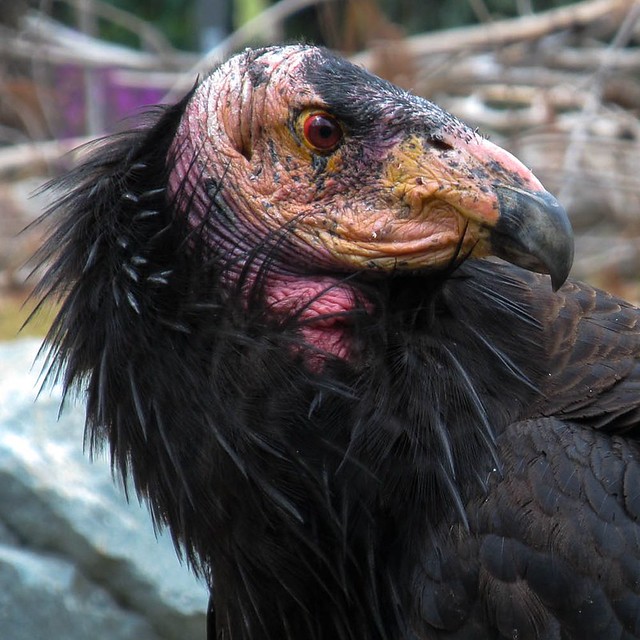
    California condor

    6) Baby pocket mice born. In an emergency rescue effort, 22 Pacific pocket mice founders were brought to the Safari Park in the summer of 2012. Housed and monitored at an off-exhibit area, this endangered species, an important seed disperser in its habitat, bred for the first time in 2013 and produced 16 offspring, which are now part of this year’s breeding efforts. Eventually, these young mice will be released into coastal habitat to bolster the remaining wild population.

    7) Island iguana population booms. Twenty years ago, Anegada iguanas were declining and in serious danger of extinction due to the heavy predation of juvenile iguanas by feral cats. Scientists from the San Diego Zoo Institute for Conservation Research partnered with the Fort Worth Zoo and the British Virgin Islands National Parks Trust in 1997 to begin raising hatchlings on Anegada Island until the juveniles were large enough to survive in the wild. To date, 179 “headstarted” iguanas have been released on Anegada Island, nearly doubling the size of the wild population.
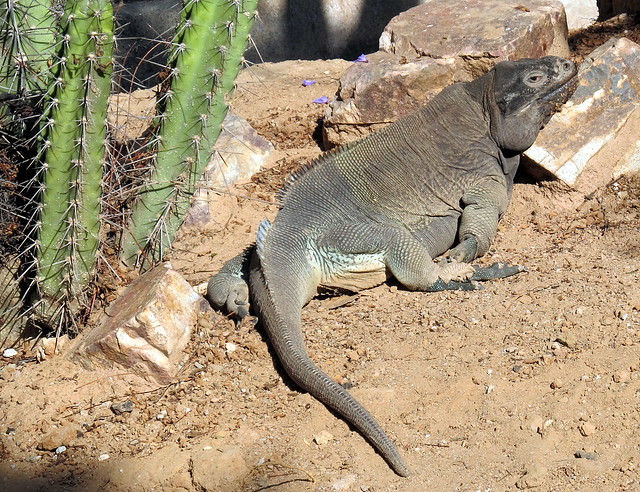
    Critically endangered Anegada Ground Iguana

    8) Gorillas protected in the wild. Ebo gorillas were identified in 2002 by San Diego Zoo Global researchers in Cameroon’s Ebo forest. Numbering less than 25 animals, the gorillas are isolated from the 2 currently recognized western gorilla subspecies and may represent a unique form of gorilla. In 2012, the San Diego Zoo’s Central Africa Program established the Clubs des Amis des Gorilles (Gorilla Guardian Clubs) in two villages located less than two miles from the gorillas’ habitat. The groups actively work to monitor and protect the rare population.

    9) First captive breeding of mangrove finch. The mangrove finch is the most threatened bird in the Galápagos Islands. Threats to the remaining 60 to 80 birds include introduced rats, cats, and disease, with the grimmest hazard being botfly larvae, which infest nests, overtaking and eventually killing chicks. San Diego Zoo Global is partnering with the Charles Darwin Foundation and the Galápagos National Park to employ hands-on techniques to nurture eggs and then chicks until they are large enough to avoid botfly infestations. To date, 15 chicks have been raised and transferred back to a release aviary within the mangrove forest on Isabela Island.

    10) Rare Hawaiian bird ready for reintroduction. In 1994, the alala (or Hawaiian crow) population dipped to just 20 birds and the species is extinct in the wild. San Diego Zoo Global’s Hawaii Endangered Bird Conservation Program has been working with the U.S. Fish and Wildlife Service and the Hawaii Division of Forestry and Wildlife to turn the tide for this last corvid in the Hawaiian Islands. Thanks to the successful breeding program at our Keauhou and Maui Bird Conservation Centers, the alala population has now increased to 108 birds. There is now the possibility of releasing alala back into the wild in coming years.

    The next time I read about a rhino poaching or a habitat that is being destroyed, I will remind myself of these successes. No matter how hard the fight, the important thing is to keep fighting; because eventually there will be another reason for hope.
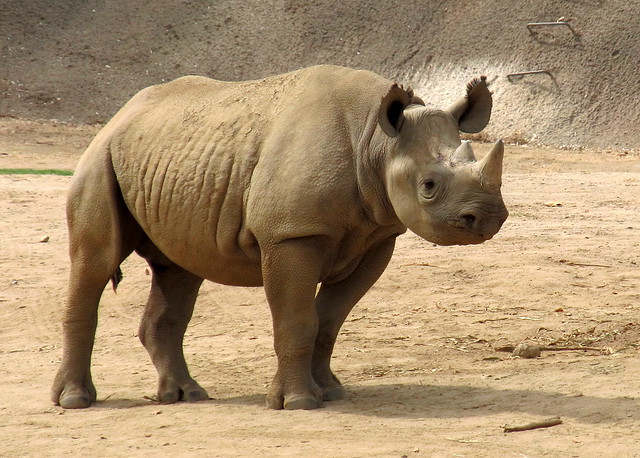
    Baby Black Rhino
    Two-year-old Black Rhino, Erik – 2012
  • Think globally, but act locally.

    For the past two years Dylan and I have been involved in fundraising for one of our favorite non-profit organizations. So involved, that I can’t remember a time that we were not raising money for one thing or another. Cans for Critters, Reading for Wildlife, Tiger Trail, a new home for the Amur and Snow Leopards, and so on. With the support and generous donations from friends and family, we have been able to surpass all of these goals to help make a better life for our animal friends at the San Diego Zoo and San Diego Zoo Safari Park. However, with such big goals (over $3,000 raised) we have not been able to give as much as we would like in other areas like animal adoptions, wish list gifts, and our monthly wildlife hero contributions.

    Many of the exclusive events Dylan and I are invited to attend throughout the year are part of the Wildlife Conservancy’s monthly donor program. Meeting scientists and hearing lectures from those who have traveled to China’s panda sanctuaries, flown over the Arctic looking for polar bear dens, or studied the breeding habits of the cheetah are just a few of the experiences we have enjoyed. Knowing that we can help and make a difference globally is what made joining the Wildlife Conservancy such an easy decision for both of us.

    We became Wildlife Hero’s on Endangered Species Day in 2012 and have been helping to save animals all around the globe ever since. I support the Wildlife Conservancy because I know that their work is making a difference locally and globally. Whether I am giving my time or my money, I feel that I am part of a family working toward a common goal of saving the world’s endangered species. Preserving wildlife, banking DNA, preventing disease, conserving habitat, restoring nature, and inspiring change are just a few of the things that my monthly donations support.

    Creating awareness for endangered species and raising money for two new exhibits, which will have our names on plaques at the San Diego Zoo Safari Park (Tiger Trail) and San Diego Zoo (Amur and Snow Leopards) is something we are both proud and honored to be a part of. We considered starting another local fundraising venture, but instead decided to take a break and focus our efforts on the big picture.

    We are thinking globally and have decided to increase our monthly Wildlife Conservancy donation so that we can make a bigger impact in the field. Locally, we will continue to make purchases from the monthly wish list and symbolically adopt animals.

    One of the wonderful things about being a Wildlife Hero is that you can do it from anywhere in the world … which brings me to our challenge for you.

    For as little as $10 a month you can become a Wildlife Hero and start making a global impact too. Visit endextinction.org today to join the fight against species extinction.


    Will you be a hero for wildlife?

  • Endangered Species Monday – African Lion

    Lions are amazing animals that have become iconic symbols of the African plain. Through movies like The Lion King, children have learned that lions are looked up to with great pride by other animals. Lions are often one of the first animals a child will learn about. Of all the big cats, lions are the ones most often associated with a roar. A roar that can be heard up to 3 miles away. These majestic cats are not listed as endangered by the IUCN, but as vulnerable – only in West and Central Africa are they classified as endangered. This status will not last long at the rate humans are killing lions.

    Lions have vanished from over 80% of their historic range. The lion population is listed as decreasing and on more than one occasion, lions have been labeled on the brink of extinction.  Aside from the fact that humans are overhunting the lion’s wild prey and destroying their natural habitat, humans are also illegally killing lions for trophies to hang on their walls. As horrible as this sounds, it is true.

    Dr. Guy Balme, Panthera’s Lion Program Director said, “Lions have slipped under the conservation radar for too long. If we do not act now, lions will find themselves in the same dire predicament as their Asian counterpart, the tiger.”

    African lions live about 10-15 years in the wild and have been known to live up to 30 years in zoos. However, the average lifespan in captivity is 20 years.

    The lioness pictured above is Tango. Tango was a Transvaal lion who was born at the San Diego Zoo on August 12, 1992. She and her sister Mweezi lived at the Safari Park for a while, where Tango gave birth to a litter of 3 cubs in 1995. Shortly after giving birth, Tango and her sister came back to the zoo where they both lived out the remainder of their lives. Mweezi passed away in 2009 and Tango left us January 20, 2013 … she was 20 years old.

    Although Tango was born and raised in captivity, she never let anyone forget that she was a wild African lion at heart … Her roars could be heard on a daily basis. Lions are social animals and it was obvious that Tango missed her sister.

    Make your voice heard and Cause an Uproar with National Geographic’s Big Cat Initiative or join the fight with Panthera on Project Leonardo. Whatever you do, however you chose to create awareness for these magnificent big cats, just remember that you can make a difference. Lions deserve to roam the African plains without the fear of being killed by man. Africa is their home and we should respect that.

  • Dylan’s Animal Adventures are now available – Come join the fun!

    What could be better than hosting your very own summer camp and teaching kids about saving endangered species? Well, for a 10-year-old boy who loves animals, not much … unless you ask him if he wants to start his own business so that he can teach more kids.

    For Dylan, this was exactly what happened. For the last few months we have been busy planning, researching, writing, and creating. The result of our combined efforts … Dylan’s Animal Adventures. 

    Dylan chooses the topic for each new booklet and then does the research so that only the most current information is shared. Michelle writes all the content and designs the adventure guides with kids in mind. Thanks to an amazing graphic artist, Steph Calvert of Hearts and Laserbeams, each adventure has new animal friends that you won’t find anywhere else.

    Dylan’s Animal Adventure Guides are a fun way to explore and learn more about endangered species, conservation, and making a difference.

    All adventure guides come with a set of coordinating coloring pages. Perfect for parents, grandparents, homeschooling parents, teachers, and anyone who just loves learning more about animals!

    So what are you waiting for? 

    Support Dylan’s passion and get your Original Adventure Guide today at
  • Are you ready to join us for Dylan’s Animal Adventures?

    Do you love adventure? Do you want to learn how you can help save endangered animals?

    Are you ready to have fun while we explore and learn more together?

    Then you won’t want to miss the launch of our new adventure … Dylan’s Animal Adventures. We have been busy putting the finishing touches on the new website and getting ready to open our Adventure Shop. Here’s a sneak peek.

    Our first booklet will be The Original Adventure Guide, which recaps what kids learned at Dylan’s Animal Adventure Camp last summer. Filled with over 30 pages of educational fun, activities, games, craft ideas, and so much more … this adventure guide will set the bar for all booklets to follow.

    A little peek at one of the pages from The Original Adventure Guide

    Yes, you read that correctly. We will be starting new adventures every 2-3 months and would love for you to join us. Be sure to follow along on Facebook and Twitter so you don’t miss out on the fun.

    Are you ready to have fun and explore with Dylan? Great!

    The adventure begins February 15, 2104

  • The Adventure Continues …

    We had so much fun sharing our love of animals with kids last summer that we wanted to continue our journey of teaching others about endangered species and conservation.

    We’ve been busy planning some exciting things since hosting Dylan’s Animal Adventure Camp last summer and it’s almost time to share our next journey with you. This is an adventure that you won’t want to miss!